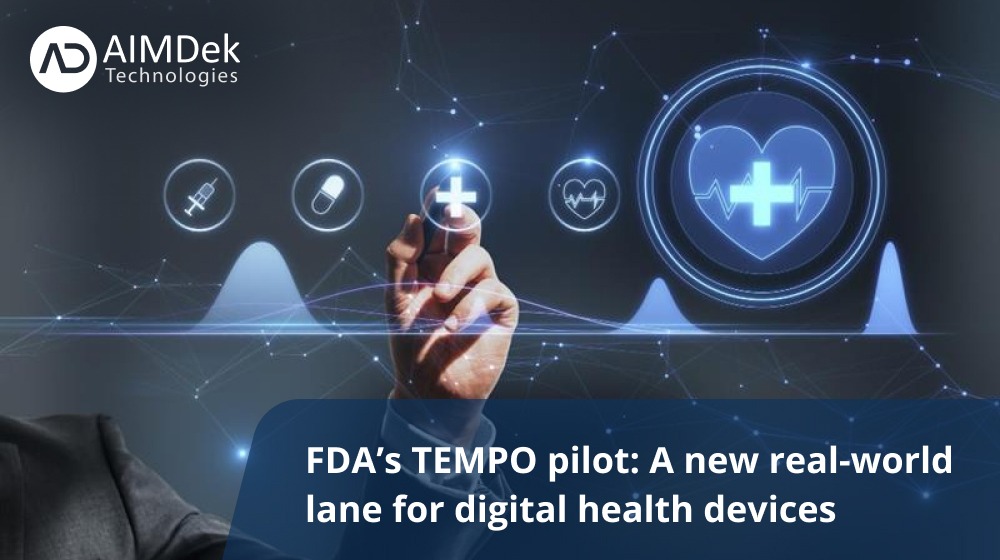
If you build digital health products, you’ve probably felt the mismatch: software iterates quickly, but healthcare evidence and access pathways often move slowly. FDA’s Technology-Enabled Meaningful Patient Outcomes (TEMPO) for Digital Health Devices Pilot is an attempt to narrow that gap by pairing real-world use with real-world learning, while still keeping safety front and center.
This post breaks down what TEMPO is, how it connects to CMS’s ACCESS model, and what it changes for builders in practical terms.
What TEMPO is
What it is: A voluntary FDA pilot designed to (1) promote access to certain digital health devices while safeguarding safety, (2) evaluate a risk-based approach to oversight, and (3) encourage innovation while collecting real-world evidence on how devices perform in real life.
What it isn’t: It isn’t a blanket “fast pass” for any health app or wearable. The pilot is explicitly framed around risk-based oversight and real-world evidence collection in defined areas.
Why FDA is doing this now
FDA’s press announcement frames TEMPO as aligning with the “rapid and iterative nature” of digital health development while expanding patient access to innovative technologies.
At the same time, CMS is pushing an outcomes-aligned approach to technology-supported chronic care via the ACCESS (Advancing Chronic Care with Effective, Scalable Solutions) Model. ACCESS is explicitly designed to expand access to technology-supported care options for preventing and managing chronic disease.
In other words: TEMPO is not happening in isolation. It is part of a broader shift where access, payment, and evidence expectations are being designed to work together.
How TEMPO connects to CMS ACCESS
CMS describes ACCESS as testing an outcome-aligned payment approach in Original Medicare to expand access to technology-supported care options to prevent and manage chronic disease. CMS also lists focus conditions including high blood pressure, diabetes, chronic musculoskeletal pain, and depression, which map closely to the use areas FDA references for TEMPO.
The Federal Register notice makes this linkage explicit: FDA is announcing TEMPO in connection with the CMMI ACCESS model, with the shared emphasis on patient outcomes and technology-supported care.
Practical takeaway for builders: TEMPO sits at the intersection of:
- Real-world use (care settings and real patients)
- Outcomes expectations (more than “engagement” or “feature adoption”)
- Evidence generation (what did the product do, for whom, under what conditions)
The use areas TEMPO focuses on and what they have in common
FDA’s announcement describes use areas that include:
- lower-acuity cardiometabolic conditions such as prediabetes
- more complex cardiometabolic conditions such as heart failure
- musculoskeletal issues such as back strain
- behavioral health conditions such as depression
The TEMPO FAQs also describe the pilot’s purpose around improving outcomes in certain conditions and learning how devices perform in real-life settings.
What these domains have in common from a product standpoint:
- outcomes are usually longitudinal (weeks to months, not minutes)
- user success depends on adherence and continuity
- real-world use creates variability (missed measurements, drop-offs, inconsistent environments)
- the product’s value is often tied to how reliably it performs under everyday constraints
“Enforcement discretion” in builder terms
FDA explains TEMPO as evaluating a risk-based enforcement approach while collecting real-world evidence to understand device performance in real-life settings.
CMS’s ACCESS technical FAQ adds a useful practical framing: TEMPO participation may be valuable for organizations developing certain devices that would generally require FDA premarket authorization, by facilitating use of those devices in a controlled context while real-world data are collected under FDA oversight.
What that means for product and engineering teams, without legal speculation:
- Your evidence story becomes inseparable from the product. It is no longer enough to ship features and hope impact is obvious.
- Your operating model matters earlier. Real-world use means you need dependable onboarding, predictable behavior, and the ability to understand performance issues quickly.
- Your changes must be explainable over time. If the product evolves during real-world learning, you need clarity on what changed and when, because outcomes only make sense in context.
What TEMPO signals for 2026 digital health strategy
TEMPO is a strong signal that the next wave of digital health winners will be built around three things:
- Outcome clarity
Teams that can define what “meaningful improvement” looks like for a real population will be in a better position than teams optimizing only for app usage. - Real-world performance discipline
Products that work in controlled demos but fail in messy reality will struggle when the evidence lens shifts from controlled environments to everyday use. - Evidence as an engineered capability
Not in the sense of paperwork. In the sense of repeatable measurement, consistent definitions, and the ability to learn from real-world performance without guessing.
If you’re building a SaMD or RPM product and want your platform to be ready for real-world performance measurement and scaled deployment, explore AIMDek’s SaMD engineering capabilities by clicking here and RPM capabilities here.

Sources
- FDA press announcement: https://www.fda.gov/news-events/press-announcements/fda-launches-tempo-first-its-kind-digital-health-pilot-expand-access-chronic-disease-technologies
- FDA TEMPO FAQs: https://www.fda.gov/medical-devices/digital-health-center-excellence/tempo-digital-health-devices-pilot-frequently-asked-questions
- CMS ACCESS model: https://www.cms.gov/priorities/innovation/innovation-models/access
- Federal Register notice (TEMPO): https://www.federalregister.gov/documents/2025/12/08/2025-22190/technology-enabled-meaningful-patient-outcomes-tempo-for-digital-health-devices-pilot
- CMS ACCESS technical FAQ (mentions TEMPO context): https://www.cms.gov/priorities/innovation/access-technical-frequently-asked-questions