At first glance, a FemTech app may look similar to other health or wellness apps. It collects data, shows trends, sends reminders, and sometimes connects to devices. But once you look a little deeper, it becomes clear that building an app for women’s health is fundamentally different. Product teams must balance user experience, clinical responsibility, privacy, and scalability from day one.
Women’s health products expand across fertility, pregnancy, menopause, chronic care, and diagnostics, FemTech apps are becoming core platforms that combine mobile experiences, data science, connected devices, and regulatory compliance.
This guide breaks down what truly matters in FemTech app development, including essential features, recommended technology stacks, cost drivers, and compliance considerations you should plan for early. To explore what engineering initiatives AIMDek can help you, visit our page on FemTech & Women’s health engineering services.
Key Features in FemTech App Development
While feature sets vary by use case, most successful FemTech apps share a common foundation.
1. User Profiles and Health Context
FemTech apps must support detailed, evolving user profiles, including:
- Age, reproductive stage, and medical history
- Cycle patterns, symptoms, and lifestyle inputs
- Pregnancy or menopause stage tracking where applicable
This contextual data powers personalization and insights, but it also increases responsibility around privacy and accuracy.
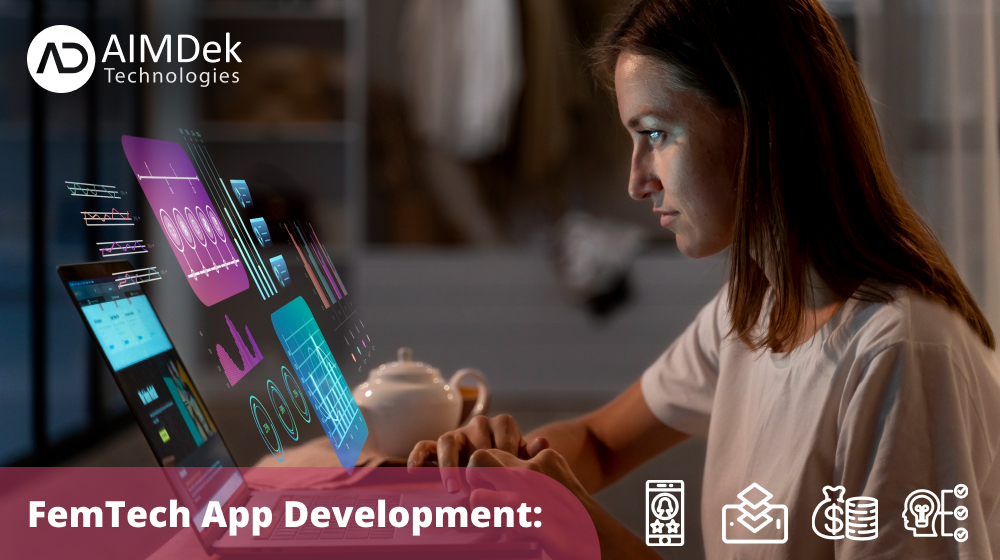
2. Health Tracking and Data Visualization
Core tracking capabilities often include:
- Cycle, symptom, or event tracking
- Trends over time rather than isolated data points
- Clear visualizations that are easy to interpret without medical training
Designing these views requires close collaboration between UX, product, and clinical advisors.
3. Personalization and Insights
Many FemTech apps offer predictive or recommendation-based features such as:
- Cycle or fertility predictions
- Symptom pattern recognition
- Personalized content or care suggestions
It is critical to clearly position these insights as informational unless the product is cleared for clinical decision support.
4. Device and Wearable Integration
Modern FemTech app development often involves:
- BLE-based wearable integrations
- Medical sensors for temperature, pH, HRV, or SpO₂
- Data synchronization with third-party platforms
Device reliability, calibration handling, and data validation become part of the app’s core responsibility.
5. Secure Communication and Engagement
Depending on the product, this may include:
- In-app messaging or chat
- Telehealth features
- Notifications and reminders tied to health context
Security and consent management must be built into every interaction.
Technology Stack for FemTech App Development
There is no single “best” stack, but proven patterns exist.
Mobile Applications
- Native iOS and Android for performance-critical or regulated products
- React Native for faster MVPs and cross-platform consistency
The choice depends on regulatory scope, device integrations, and long-term roadmap.
Backend and APIs
- Node.js, Java, or Python-based services
- REST or GraphQL APIs for scalability
- Role-based access and audit logging built-in
Backend architecture must support long-term data growth and compliance audits.
Cloud Infrastructure
- AWS, Azure, or GCP with healthcare-ready configurations
- Encrypted storage and secure key management
- Regional data residency where required
Infrastructure decisions directly impact compliance and cost.
Data and Analytics
- Secure relational or time-series databases
- Analytics focused on trends, not raw exposure
- Monitoring for data drift, quality, and system health
Data handling is often the most underestimated part of FemTech app development.
If you are starting out on building something in FemTech, read our guide on Building FemTech Products: MVP to Scale.
Compliance and Regulatory Considerations
Compliance is not an add-on in FemTech. It shapes architecture, UX, and even feature scope.
Key considerations include:
- HIPAA for handling protected health information in the US
- GDPR for user consent, data minimization, and deletion rights in the EU
- FDA guidance for digital health, wearables, and clinical decision support
- EU MDR implications if the app connects to regulated medical devices
Even apps positioned as “wellness” must be careful not to cross regulatory boundaries unintentionally.
Cost Considerations in FemTech App Development
There is no fixed cost for building a FemTech app, but several factors strongly influence budget.
Major cost drivers include:
- Depth of health tracking and personalization
- Device or wearable integrations
- Compliance and validation activities
- Data security and infrastructure setup
- MVP versus scale-ready architecture
A lightweight MVP may focus on core tracking and UX, while a production-ready FemTech platform requires investment in quality, validation, and long-term maintainability.
In general, an initial MVP app may cost anywhere between $20,000- $50,000 depending on above factors, whereas a complete end-to-end medical grade app with various integrations may cost $100,000 and upwards. There really is no single one-size-fits-all quote, but you can reach out to us with your requirement, and we can give you a quote with a free consultation call on your roadmap.
Common Challenges in FemTech App Development
Teams often face challenges such as:
- Over-promising medical value without regulatory clearance
- Underestimating data privacy and consent complexity
- Scaling from MVP to a compliant commercial product
- Handling real-world device data inconsistencies
- Maintaining user trust over long engagement cycles
Addressing these early reduces rework and regulatory risk later.
How to Choose a FemTech App Development Partner
When selecting a FemTech app development company, look beyond technical skills alone.
Key evaluation criteria should include:
- Experience in women’s health or digital health products
- Strong understanding of compliance and quality frameworks
- Ability to integrate hardware, cloud, and mobile platforms
- A product mindset that supports long-term scale, not just MVP delivery
FemTech products often evolve into regulated platforms. Your development partner should be prepared for that journey.
Final Thoughts
FemTech app development sits at the intersection of technology, healthcare, and lived experience. Success depends on building systems that are secure, trustworthy, and adaptable as regulatory and clinical expectations evolve.
Teams that invest early in the right features, architecture, and compliance foundations are far better positioned to scale responsibly and sustainably. If you are planning a FemTech or women’s health app and want to validate your feature scope, tech stack, or compliance approach before building, a structured discovery phase can save significant time and cost later.