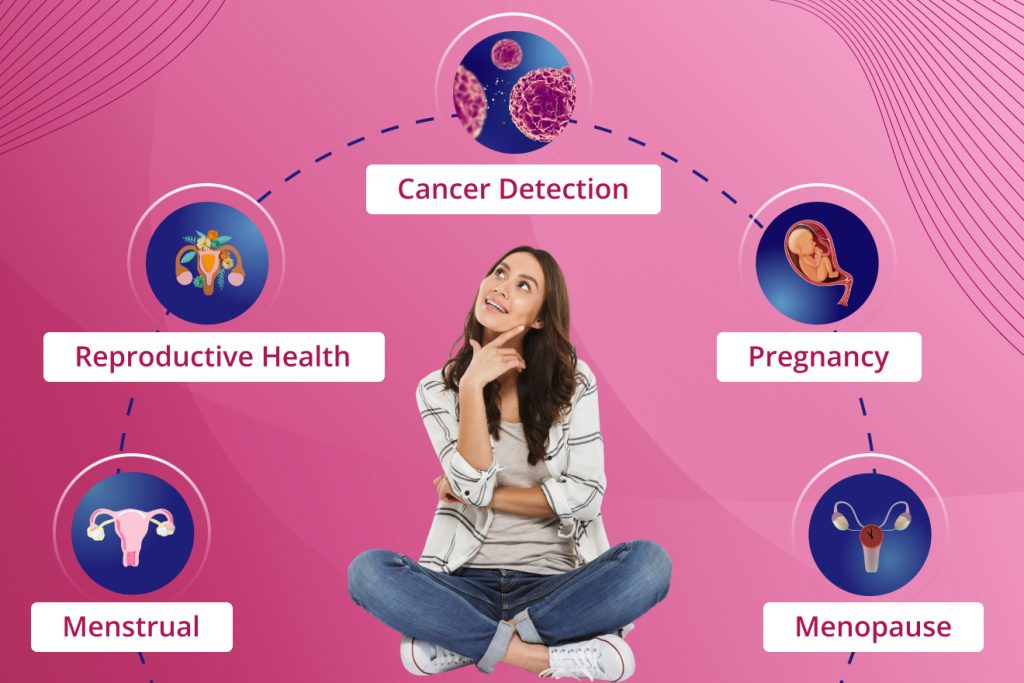
FemTech isn’t one product category. It’s a set of health journeys that span life stages, risk levels, and care models. Women’s health innovation is often discussed across areas such as menstrual health, pregnancy and nursing, menopause, contraception and reproductive health, sexual and pelvic health, and other conditions that disproportionately affect women.
This guide breaks down five core FemTech categories and shows how to translate each into a product strategy: what users actually need, what to build first, what data and integrations matter, and what quality and privacy expectations come with the territory.
If you’re building an AI-enabled women’s health product, AIMDek supports FemTech & women’s health software and hardware development with design-led engineering for apps, platforms, devices, integrations, quality, and scale. Learn more by clicking here.
Table of contents
- How to use this categories guide
- The shared building blocks across all FemTech categories
- Category 1: Menstrual health
- Category 2: Menopause
- Category 3: Pregnancy
- Category 4: Reproductive health
- Category 5: Cancer detection and screening support
- Choosing your wedge: a simple decision framework
- How AIMDek can help
How to use this categories guide
Each category section includes:
- Primary user jobs (what they’re trying to achieve)
- MVP scope (what to build first without overbuilding)
- Data and integrations (what improves outcomes and retention)
- Quality and trust risks (what can break trust fast)
- Scale path (what you add once retention is proven)
The shared building blocks across all FemTech categories
Even though the journeys differ, successful FemTech products usually share five foundations:
1) Trust-first UX for sensitive data
FemTech products often touch intimate topics. Users expect clarity, control, and respectful design. Treat consent, privacy controls, and safe defaults as core product requirements.
2) A clear “track → interpret → act” loop
Retention improves when users can do three things repeatedly:
- capture minimal, high-signal inputs
- see an insight they understand
- take a next step that feels safe and relevant
3) Interoperability readiness
Modern women’s health products increasingly connect to wearables, labs, telehealth, and EHR ecosystems. Interoperability is becoming a growth lever, not an optional add-on.
4) Evidence and quality discipline that matches risk
Not every FemTech product is regulated, but every FemTech product can cause harm if it is wrong, misleading, or leaks data. Your testing and validation posture should scale with risk.
5) Lifecycle thinking
FemTech teams often start direct-to-consumer and then expand into partnerships. That transition is smoother when you build durable foundations early (security, monitoring, traceability habits).
Category 1: Menstrual health
What users want
- Understand cycle timing and variability
- Track symptoms and triggers without friction
- Feel confident about patterns without being misled
- Reduce anxiety and feel in control
MVP scope that works
- Simple cycle and symptom tracking with high-signal inputs
- Clear cycle views and trend summaries
- “What might be influencing this?” prompts (not medical claims)
- Export/share summary for clinician conversations
Data and integrations that matter
- Wearable context can improve insights and reduce manual burden (sleep, temperature trends, recovery). Wearables are becoming a major innovation area across women’s health categories.
- If you integrate wearables, design for incomplete data and show “last sync” and data completeness.
Quality and trust risks
- Overconfident predictions that feel like medical advice
- Privacy harm from sharing or re-identification of sensitive data
- Poor UX around irregular cycles leading to churn
Scale path
- Personalization by cohort (life stage, irregularity patterns, conditions)
- Support for related conditions (PCOS, endometriosis support journeys)
- Partner pathways: telehealth, coaching, labs
Category 2: Menopause
What users want
- Symptom understanding and normalization (“is this common?”)
- Personalized strategies (sleep, stress, nutrition, lifestyle, care navigation)
- Tracking that does not feel like work
- Confidence and support over months, not days
MVP scope that works
- Symptom journal with low-friction inputs and trend views
- “Triggers and patterns” summaries with uncertainty framing
- Education modules that are staged by symptom cluster
- Habit and adherence loop with user-controlled reminders
Data and integrations that matter
- Wearables for sleep and recovery context can reduce manual effort
- Partner integrations: coaching, telehealth, scheduling, content providers
- Optional clinician summary export
Quality and trust risks
- Claiming outcomes you cannot support (“this will fix…”)
- Generic recommendations that feel invalidating
- Missing escalation cues for urgent symptoms
Scale path
- Programs and cohorts (perimenopause vs postmenopause)
- Care pathways and referrals
- Population insights for partners (with privacy controls)
Category 3: Pregnancy
What users want
- Week-by-week guidance that feels reliable and calm
- Symptom tracking with clear “when to seek care” rules
- Appointment, test, and plan organization
- Support for partners and caregivers where relevant
MVP scope that works
- Gestational timeline with personalized checklists
- Symptom tracking + safe escalation guidance
- Appointment and test reminders
- “Questions for my clinician” builder and exportable summary
Data and integrations that matter
- Telehealth and messaging integrations (if you have care workflows)
- Lab result ingestion (partner or user-import lanes)
- Device and wearable integrations can help, but only if the value is clear
Quality and trust risks
- High-stakes scenarios where wrong guidance can cause harm
- Inadequate escalation handling
- Reliability: downtime or lost data is especially damaging here
Scale path
- Postpartum and nursing journeys (continuity)
- Care team portals (if you move toward provider partnerships)
- Interoperability expansion (EHR workflows, structured summaries)
FemTech discussions often place maternal health and pregnancy care as central subsectors, which is also reflected in ecosystem taxonomies and market segmentation.
Category 4: Reproductive health
This category is broad. It often includes fertility, contraception, and reproductive system health support. Many overviews of FemTech explicitly include contraception and reproductive health as core areas.
What users want
- Help making decisions with clarity and confidence
- Tracking that supports a goal (trying to conceive, preventing pregnancy, cycle understanding)
- Reliable guidance on timing, symptoms, and next steps
- Pathways to care when needed
MVP scope that works
- Goal-based onboarding (TTC vs contraception vs “understand my body”)
- Minimal tracking model aligned to the goal
- Clear education plus uncertainty framing
- Care navigation: “when to seek help” prompts and resources
Data and integrations that matter
- Wearables can add context (temperature trends, sleep)
- Partner integrations with fertility clinics, labs, telehealth can be high leverage, but add complexity
- If you enter clinical workflows, plan for interoperability standards readiness
Quality and trust risks
- High potential for perceived harm if the product feels inaccurate
- Overpromising outcomes
- Privacy and data sharing concerns are especially sensitive here
Scale path
- Partner pathways (clinics, labs, employer programs)
- More robust validation posture if you cross into decision support territory
- Cohort and equity analysis if you use AI
Category 5: Cancer detection and screening support
This is typically the highest-stakes category in your list. It often involves imaging or clinical workflows, and quality expectations are far higher than standard wellness apps.
What users and care teams want
- Earlier detection support and reduced missed cases
- Confidence in performance across diverse populations
- Clear clinical utility, not just model accuracy
MVP scope that works (in most cases)
For most teams, a safe “MVP” is not a detection model shipped to users. It’s usually:
- workflow enablement tools (navigation, education, scheduling, follow-up adherence)
- patient-reported symptom capture and structured summaries
- decision support that stays within defined scope, with clinician oversight
Evidence reality check
Peer-reviewed literature notes FDA clearance of multiple AI products for breast cancer screening support in recent years, while also highlighting open questions about accuracy, appropriate use, and clinical utility.
If you are building or integrating AI in screening workflows, plan for rigorous evaluation, monitoring, and governance.
You can also see how specific cleared tools describe intended use in FDA 510(k) summaries, which typically emphasize “assistive” roles for clinicians rather than autonomous diagnosis.
Quality and trust risks
- Clinical risk and regulatory exposure
- Bias and uneven performance across cohorts
- Trust loss if outcomes appear inconsistent or unexplainable
- Data governance and consent complexity
Scale path
- Formal clinical validation programs
- Post-market monitoring and drift management
- Tight integration into clinical workflows (often via standards like FHIR and SMART-on-FHIR patterns when embedded into EHR contexts)
Choosing your wedge: a simple decision framework
If you’re deciding where to start, use three questions:
- Which category has the clearest recurring loop?
Menstrual and menopause often have strong daily/weekly loops. Pregnancy is time-bound but high engagement. Reproductive health varies by goal. - What is your risk posture?
Cancer detection and clinical decision support require the strongest evidence and quality maturity. - Where is your fastest distribution path?
Direct-to-consumer, partner-led programs, clinics, employers, or device ecosystems.
FemTech sector maps and market segmentation commonly show these areas as distinct subsectors with different product types and go-to-market models.
How AIMDek can help
AIMDek supports FemTech teams across categories, from MVP to scale, with engineering that prioritizes trust, privacy, and long-term maintainability. We help teams build women’s health apps and platforms, connect to wearables and health ecosystems, implement quality and testing discipline, and design architecture that scales into partnerships.