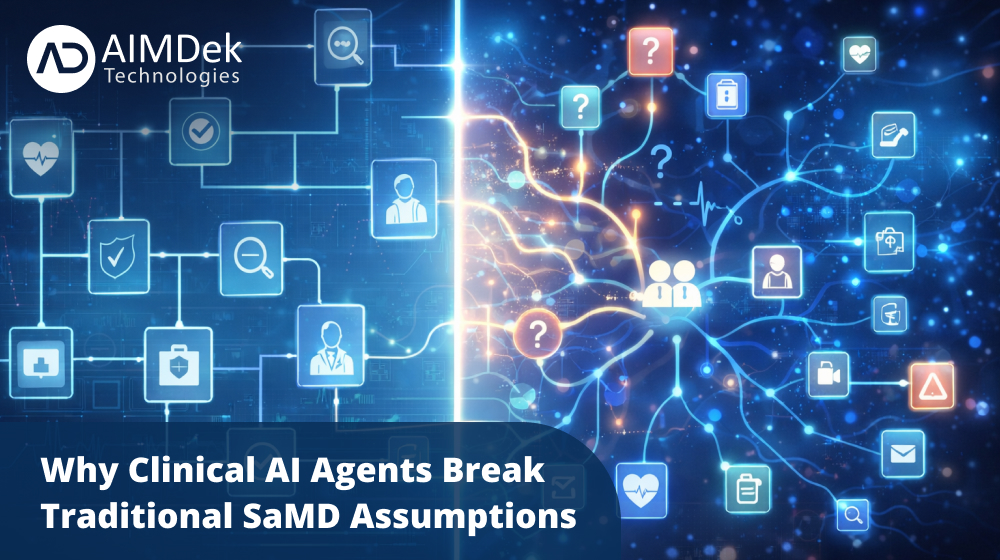
Software as a Medical Device, or SaMD, frameworks were built around a practical assumption: medical software could usually be bounded by a defined intended use, a reasonably predictable input-output pattern, and a testable validation approach. That logic still works for many forms of clinical decision support software. But clinical AI agents are starting to break those assumptions.
As healthcare AI moves from confined models toward open-ended, language-driven systems, product and engineering teams are facing a different class of problem. Clinical AI agents, including LLM-based and generative AI in healthcare applications, do not always behave like traditional medical software. They can respond to unstructured prompts, generate open-ended outputs, and show non-deterministic behavior across runs. That creates real challenges for validation, workflow design, and safety control in SaMD-like environments. Many AI-enabled clinical decision support systems still fit current SaMD logic, but generalized clinical decision support systems that are not anchored to specific clinical indications create a meaningful regulatory and engineering gap.
In this article, we look at why clinical AI agents challenge traditional Software as a Medical Device assumptions, what this means for clinical decision support software, and how engineering teams should rethink validation, intended use, and safety controls.
What traditional Software as a Medical Device (SaMD) assumptions were built for
Traditional SaMD assumptions worked best for bounded software.
Earlier generations of clinical software were easier to validate because they behaved within narrower limits. Deterministic systems were built around known fixed input-data-output-label relationships, such as binary disease classification or categorical risk stratification. Later confined clinical software, including many deep learning systems, still operated within a bounded output spectrum, even if the internal relationships were more complex. In both cases, the systems remained more amenable to evaluation under existing FDA-SaMD approaches because the outputs were constrained enough to test against structured datasets.
That distinction matters for anyone building medical AI products today.
A bounded clinical decision support software system does not have to be simple. It can still be statistically sophisticated, clinically meaningful, and safety-critical. But it is easier to characterize. Its intended use is easier to state. Its outputs are easier to enumerate. Its failure modes are easier to anticipate. And its medical software validation strategy can more plausibly map to expected outputs and representative datasets.
One of the hidden strengths of traditional SaMD logic was not just that software could be regulated. It was that the software could be sufficiently bounded for validation, labeling, and risk classification to stay meaningful.
Why clinical AI agents behave differently from traditional medical software
Clinical AI agents change that starting point.
General-purpose clinical decision support systems built on transformer-based large language models operate across an open-ended semantic space in response to unstructured prompts. That introduces a different class of risk, including outright errors and hallucinations.
That is a major shift from traditional medical software.
A conventional clinical decision support software product might output a score, a classification, a flag, or a recommendation within a tightly defined workflow. A clinical AI agent may summarize, explain, draft, triage, answer, guide, or suggest next steps in natural language. It may also adapt its output style based on the user prompt, the surrounding context, or the system configuration.
Once the product behaves that way, failure no longer looks only like a wrong class label.
Failure can mean missing context, misleading framing, unsafe phrasing, overconfident reasoning, a plausible but weak recommendation, or device-like output generated from incomplete information. Hallucinations in LLM systems are semantic errors, which makes them especially difficult to control in healthcare contexts.
That is why clinical AI agents do not fit neatly into the assumptions behind older Software as a Medical Device models. The output space is not just larger. It is semantically open-ended.
How open-ended outputs challenge clinical decision support software validation
This is where the engineering burden starts to change.
Traditional clinical decision support software validation assumes that the output space is narrow enough to test meaningfully. If the system is supposed to classify, score, or detect within a predefined range, then the validation question is relatively direct: does it produce acceptable outputs for representative inputs?
Open-ended clinical AI systems make that harder.
Generalized clinical decision support systems built on LLMs are not anchored to specific clinical indications in the same way as earlier systems. Because they respond to free-text prompts across a broad semantic surface, they introduce risks that are not captured well by conventional dataset-based evaluation alone.
For engineering teams, that means validation has to expand beyond benchmark performance.
It is no longer enough to ask whether the model gets the right answer on a test set. Teams also have to ask:
- What kinds of outputs can this system generate for ambiguous prompts?
- When does assistive language become recommendation-like language?
- How does the system behave when clinical context is incomplete?
- What happens when the user prompt is vague, contradictory, or adversarial?
- Which plausible outputs are acceptable, and which are unsafe?
That is a different testing problem from classic Software as a Medical Device validation, because the system is no longer operating within a tightly enumerable output space.
Why non-determinism changes SaMD validation for healthcare AI
Another important break is non-determinism.
Transformers are deterministic at their core, but non-determinism may be introduced through mechanisms such as temperature-based sampling or even floating point inconsistencies. In practice, that means the same prompt may yield a probabilistically sampled range of outputs that is difficult to confine. This limits the usefulness of traditional dataset-driven evaluation based on exhaustive testing with large datasets.
This changes what medical software validation means in practice.
In a more traditional SaMD setting, validation often focuses on whether a given input maps reliably to an expected output. In a clinical AI setting, especially one involving LLM in healthcare workflows, the better question is often whether the range of plausible outputs remains safe and acceptable.
That is a subtle but important shift.
You are no longer validating only a point answer. You are validating behavior across a distribution of possible outputs.
Repeated sampling and adjudication, including judge-style evaluation loops, can help assess aggregate output validity across multiple runs.
For healthcare AI teams, this means one successful run is not enough. Validation has to account for consistency, edge-case behavior, and repeatability under realistic workflow conditions.
Why intended use is harder to contain in generative AI in healthcare
Traditional SaMD frameworks rely heavily on intended use. That model works best when a regulated manufacturer distributes software through a clearly bounded interface and a defined workflow.
Current frameworks are heavily label-driven and based on manufacturer-designated intended use, which works better for earlier clinical software delivered through customized applications. But direct-to-consumer LLM systems fit less neatly into that model, especially when providers control the stack from base model to interface and broad disclaimers are used while scaling access to a wide user base. General-purpose disclaimers are unlikely to prevent real-world clinical use.
That should be a major product lesson for teams building generative AI in healthcare.
Intended use is not just a regulatory sentence. It is also a system property. It depends on who can use the system, how the interface frames authority, what the outputs sound like, what actions are enabled, and whether the workflow keeps the product inside its claimed boundaries.
A disclaimer does not reliably enforce any of that.
If a clinical AI system can produce persuasive medical-sounding output in response to open-ended prompts, then the line between assistive software and device-like behavior is not being enforced by labeling alone. It has to be enforced by architecture, workflow design, and safety controls.
Why distribution and workflow controls matter in AI clinical decision support
Another reason old assumptions break is that traditional SaMD logic quietly depended on controlled distribution pathways.
Broad-access LLMs lack some of the consumer protections associated with traditional SaMD distribution, including appropriate user selection, right-sighting of care, and adverse event monitoring. In high-risk situations, they may provide seemingly credible but inappropriate device-like recommendations based on incomplete clinical information.
This matters because AI clinical decision support is not only about model quality. It is also about delivery context.
A clinical AI product lives inside a workflow. It reaches a particular user at a particular moment, with a particular level of clinical context and authority. Once access becomes broad and interaction becomes open-ended, the risk surface gets larger.
That means engineering teams need to think beyond prompt optimization or answer quality. They need to design for:
- role-based access
- escalation logic
- refusal behavior
- emergency handling
- auditability
- post-deployment monitoring
- downstream workflow consequences
Even administrative or documentation-focused AI tools in healthcare can create clinical harm if hallucinated outputs feed downstream decisions, diagnosis labeling, claims handling, or insurance outcomes.
So the question is not only whether the model is accurate. The question is whether the full system behaves safely in real use.
What engineering teams building clinical AI and SaMD should do differently
If clinical AI agents challenge traditional Software as a Medical Device assumptions, then the response cannot be limited to stronger disclaimers or a more polished intended-use statement. Engineering teams need a more realistic operating model.
First, validation needs to become more scenario-driven. Exhaustive dataset-based validation becomes less feasible for unconfined non-deterministic systems. Teams need to test across realistic prompt variations, ambiguous inputs, incomplete context, repeated runs, and high-risk scenarios, not just curated benchmarks.
Second, workflow boundaries need to be engineered explicitly. If the model itself is harder to contain, then the system around the model has to do more of the safety work. That includes narrowing what the system is allowed to do, where it is used, when it must escalate, and how uncertainty is surfaced to the user.
Third, safety has to be layered. Safeguards such as red teaming, guardrails, agent-agent moderation, and confined retrieval-augmented generation each help in different ways, but none is enough on its own. Red teaming can expose vulnerabilities and bring clinicians into evaluation earlier. Guardrails can help filter unsafe output but may not cover the full range of non-deterministic outputs and can still be bypassed. RAG can ground outputs in trusted sources but narrows versatility and can fail when retrieval context overpowers the local query.
Fourth, post-deployment oversight matters more. Ongoing quality controls are especially important for direct-to-consumer systems and any workflow where unsafe outputs can create downstream harm.
The practical takeaway is simple: clinical AI safety cannot be treated as a one-time model validation exercise. It has to be treated as a system design problem.
Clinical AI agents are changing the Software as a Medical Device playbook
Not all clinical AI falls outside traditional SaMD thinking. Many clinical decision support systems, including AI-enabled ones, are still addressed by current guidelines and broader SaMD frameworks. The real issue is narrower and more important: generalized, unconfined, and potentially non-deterministic clinical AI systems do not fit the assumptions that made older Software as a Medical Device validation and labeling work as cleanly as they once did.
That distinction matters.
Because once you see the problem clearly, the path forward also becomes clearer. The challenge is no longer just model performance. It is whether the product can be bounded by workflow, evaluated across realistic behavior, monitored after deployment, and supported by layered safeguards that hold up in real healthcare environments.
Clinical AI agents are not simply better models inside the old medical software box.
They change the shape of the box.
FAQs
Software as a Medical Device refers to software intended for medical purposes that performs those purposes without being part of a hardware medical device. Current SaMD frameworks can still apply to many forms of clinical decision support software and AI-enabled medical software.
Clinical AI agents often respond to unstructured prompts and generate open-ended semantic outputs, rather than selecting from a tightly bounded set of labels or actions. That makes their behavior harder to fully characterize and validate using older software assumptions.
Because repeated runs may not always produce the same output. When systems generate a range of plausible responses, validation has to assess behavioral consistency and safety across that range, not just a single answer.
Not always. Some healthcare AI applications still fit traditional clinical decision support software and SaMD frameworks, but generalized systems that are not anchored to specific clinical indications create a different regulatory and engineering challenge.
They should move beyond benchmark-only validation and design for scenario testing, repeated-run evaluation, stronger workflow boundaries, layered safeguards, and post-deployment monitoring.
Building Clinical AI That Holds Up in the Real World
Model performance is only one part of the challenge. Safer healthcare AI also depends on workflow boundaries, validation strategy, escalation design, and system-level safeguards.